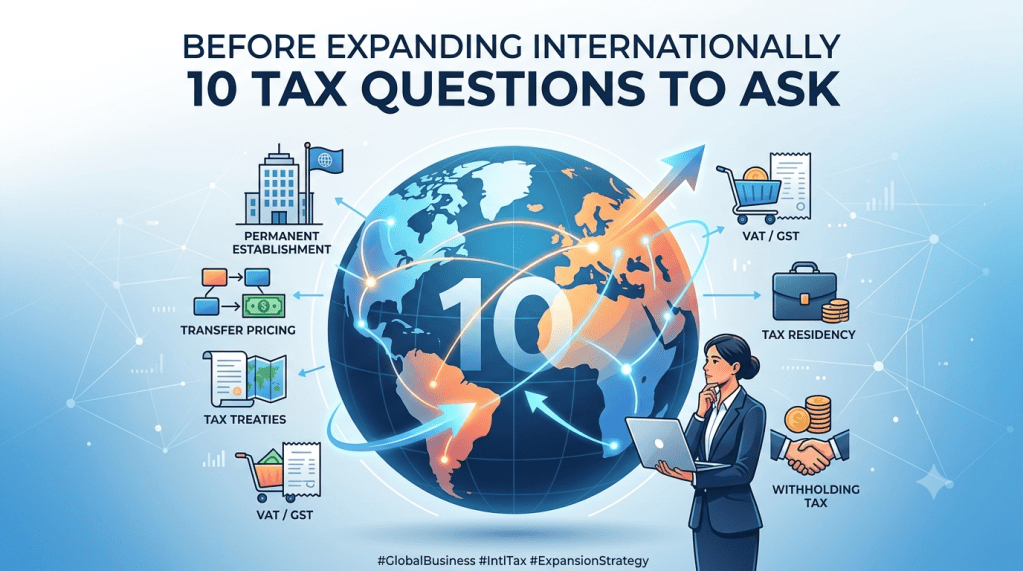
Expanding into international markets may help your business grow, but tax matters can become complicated quickly. Since each country has its own set of rules, failing to take account of any one of them could result in unexpected bills or fines.
So, before you decide to expand, ask yourself the following ten simple questions.
1. Will my business overseas create a “permanent establishment”?
Tax authorities might consider that you have a taxable presence in that country if you open an office, a warehouse, or if your staff frequently conclude deals there. This situation usually requires you to pay the local corporate taxes and to file tax returns. Since even minor activities can trigger this, it is important to check the rules as early as possible.
2. In which country will my company be regarded as having a tax resident?
In some countries you are taxed according to the place where the company is registered, while in others the location of the important decisions is taken into account. If you get this wrong you might end up paying tax on the same income in more than one place, so it’s important to understand the rules in both your home country and the new market.
3. Should I set up a branch or a subsidiary?
While a branch is easier to set up, the profits from it are generally taxed as part of the main company. A subsidiary, on the other hand, is a separate legal entity and is taxed independently. The different choices you make have an impact on liability, the tax rates, and the ease with which you can bring money back home. You should carefully consider the options.
4. How should I price the deals between my related companies?
If you are selling goods, services, or licenses from your home office to an overseas company (or the other way around), the prices used must be fair. This means they should be the same as if the companies were independent of each other. This practice is known as transfer pricing. It is important to keep proper records since tax authorities frequently examine such transactions.
5. What taxes will be deducted from the payments we make or receive between countries?
When dividends, interest, royalties, or service fees are paid to a different country, they are usually subject to a withholding tax. Although tax treaties between countries can reduce these rates, you generally have to complete the correct forms in order to get the advantage. Make sure you know the rates and the rules before the money is transferred.
6. Are there tax treaties which enable us to avoid being taxed twice?
There are agreements in many countries which specify which country has the right to tax certain income and allow either the reduction or elimination of double taxation. You should verify whether a treaty applies and what documentation is required to use it.
7. Regarding sales taxes, VAT, or GST, what do we have?
Even if you only sell online or have no physical office, many countries still require you to register and collect value-added tax (VAT) or goods-and-services tax (GST). Thresholds can be low, and failing to register can bring big fines.
8. What tax and social security provisions apply when we employ people in other countries?
When you have local employees, you are generally required to deduct income tax, make payments towards social security or healthcare, and comply with local labor regulations. You should plan for these costs and responsibilities.
9. When and in what way will profits earned abroad be taxed in my home country?
In some countries, the profits remain untaxed in your home country until you bring them back, while in other cases they are taxed immediately. It is important that you understand how the tax system in your home country operates before you decide to expand.
10. Are we prepared to handle all the filings and reporting?
You’ll probably be required to submit local tax returns, VAT returns, transfer-pricing reports, and possibly reports on foreign bank accounts as well. Failure to meet the deadlines or to complete the forms could result in fines. Make a simple checklist and seek advice from experts familiar with the local regulations.
Final tip
Tax rules vary from country to country, and it’s a good idea to consult a reliable tax advisor before you decide to expand business operations to save time and money and reduce stress. With proper planning, tax matters can be transformed from a potential risk into a component of a sound growth strategy.
Have a Cross-Border Structure — or Planning One?
If you’re setting up or already running an international structure, it’s worth getting a second opinion before the compliance gaps become expensive.


Leave a comment